


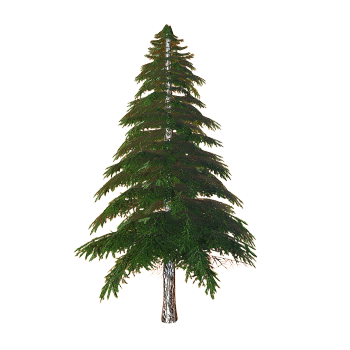
Spring spruce trees
Abies is an evergreen tree in the genus Abies of the pine family, also known as Canadian fir, North American fir, and Balsan desert fir. Plants can grow up to 8-20 meters in height; The bark of the old tree is thick and dark reddish brown, with scaly lobes. The young trees are relatively smooth, gray, and the young branches are light yellow green with gray short hairs; Winter buds are small, nearly spherical or broadly ovoid, with resin; The leaves on a tree undergo significant changes, with two rows of flat, dark green leaves arranged on either side.
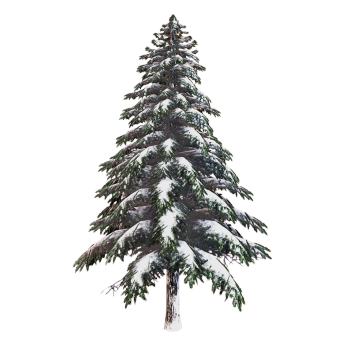
Winter spruce trees
Abies is an evergreen tree in the genus Abies of the pine family, also known as Canadian fir, North American fir, and Balsan desert fir. Plants can grow up to 8-20 meters in height; The bark of the old tree is thick and dark reddish brown, with scaly lobes. The young trees are relatively smooth, gray, and the young branches are light yellow green with gray short hairs; Winter buds are small, nearly spherical or broadly ovoid, with resin; The leaves on a tree undergo significant changes, with two rows of flat, dark green leaves arranged on either side.

3D model of mountain ripples
Beilschmiedia appendiculata (C. K. Allen) S. K. Lee&Y. T. Wei): a small tree in the family Lauraceae and genus Cymbidium, with a height of 6-30 meters and a diameter at breast height of up to 60 centimeters; The bark is grayish yellow. The apical bud is densely covered with gray brown short hairs. Branchlets are hairless or covered in soft hairs, often thick and slightly angular. Leaves opposite or alternate, fruit elliptical or ovate elliptical, 1-1.8 cm long, about 1 cm in diameter, often with small nodules, green when immature, black when mature; The stem is 1.5-2 millimeters thick.
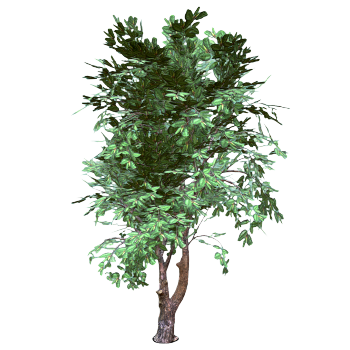
Laurel 3D model
Laurel, scientific name: Laurus nobilis L., is an evergreen tree belonging to the Lauraceae family and the Lauraceae genus. It is distributed in Asia, Europe, and Africa, and has been introduced to many countries including China. Up to 12 meters tall, leathery leaves, oblong or oblong lanceolate, apex pointed or gradually pointed, petiole purplish red; The inflorescence bracts are nearly round, hairless, and the lobes are oblong or nearly round; The fruit is dark purple oval shaped; The flowering period is from March to May, and the fruiting period is from June to September. The name Laurel comes from the Greek mythological goddess Laurel.
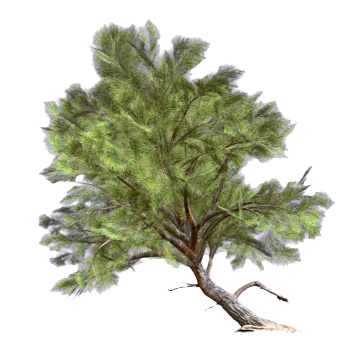
Mediterranean pine 3D model
Mediterranean pine (scientific name: Pinus haleepensis), also known as Aleppo pine, is a tree species in the pine genus, native to all low altitude areas around the Mediterranean Sea. Mediterranean pine is generally found at altitudes below 200 meters (660 feet), but can grow up to 1000 meters (3300 feet) in southern Spain, 1200 meters (3900 feet) in Crete, and can also be found in areas up to 1700 meters (5600 feet) above sea level in Morocco, Algeria, and Tunisia.
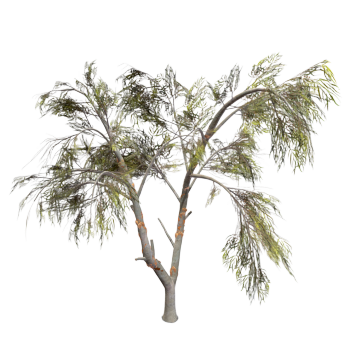
Eucalyptus 3D model
Eucalyptus spp. (scientific name: Eucalyptus spp.) is a collective term for plants in the Eucalyptus, Eucalyptus, and Eucalyptus genera of the Myrtle family. Most of them are evergreen trees with a wide variety of species. Eucalyptus is derived from the transliteration of French by modern Chinese scholar Wu Zonglian. "Eucalyptus" is related to "case" in ancient Chinese and is named "Eucalyptus", which means that its material can be used to make objects. Eucalyptus also has the function of treating diseases and preventing epidemics. The name "Eucalyptus" means safe but not dangerous.
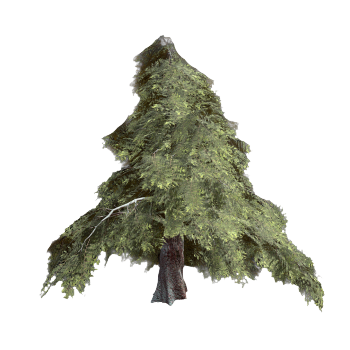
Truncated Southern Ocean Cedar
Araucaria cunninghamii Mudie is a tree in the family Araucaria and genus Araucaria. It can grow up to 60-70 meters tall in its native area, with a diameter at breast height of over 1 meter. The bark is gray brown or dark gray, thick, and horizontally split; The large branches are flat or slanting, with a pointed tower shaped crown for young trees and a flat top shape for older ones. The lateral branches are densely distributed and drooping, arranged in a nearly feather like pattern. Southern fir is not cold resistant and should avoid drought. It needs sufficient sunlight in winter; Originating from the southeastern coastal areas of Oceania, it is cultivated in open fields in Guangdong, Fujian, Taiwan, Hainan, Yunnan, Guangxi and other places in China.
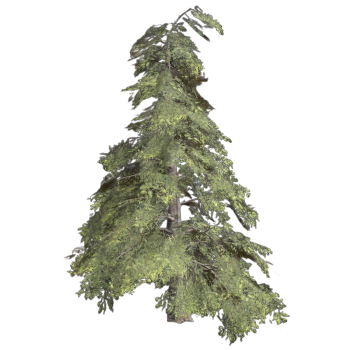
3D Model of Southern Ocean Cedar
Araucaria cunninghamii Mudie is a tree in the family Araucaria and genus Araucaria. It can grow up to 60-70 meters tall in its native area, with a diameter at breast height of over 1 meter. The bark is gray brown or dark gray, thick, and horizontally split; The large branches are flat or slanting, with a pointed tower shaped crown for young trees and a flat top shape for older ones. The lateral branches are densely distributed and drooping, arranged in a nearly feather like pattern. Southern fir is not cold resistant and should avoid drought. It needs sufficient sunlight in winter; Originating from the southeastern coastal areas of Oceania, it is cultivated in open fields in Guangdong, Fujian, Taiwan, Hainan, Yunnan, Guangxi and other places in China.
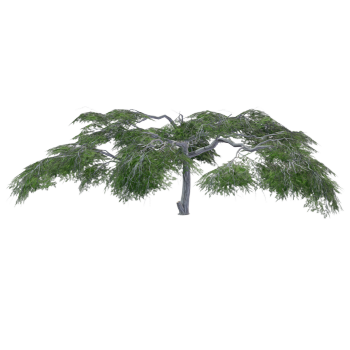
3D model of Acacia tree
Acacia farnesiana (L.) Wight&Arn Fabaceae is a shrub of the genus Acacia, whose stem surface is rough and appears black brown; The supporting leaves are thorny and sharp, the compound leaves are feather shaped, and the small leaves are linear and rectangular in shape; Its flowers are numerous and dense, mostly spherical in shape, with a yellow color and fragrant taste; The fruit is cylindrical in shape, while the seeds are oval in shape, mostly brown. Its flowering period is in spring, and its fruiting period is in summer and autumn. Due to its golden appearance when in full bloom, it is named Acacia.
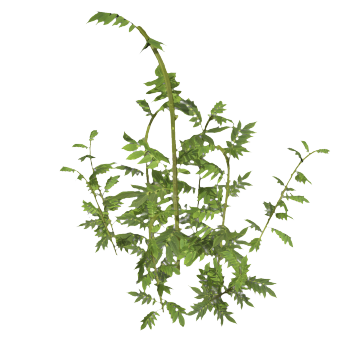
Taxus seedlings
Taxus wallichiana var. chinensis (Pilger) Florin, a species of evergreen tree or shrub in the Taxaceae family, can grow up to 30 meters tall. Leaves lanceolate or needle shaped, arranged in a spiral or alternating manner; Dioecious plant; Male bulbous flowers are often solitary or form spike like inflorescences; Female bulbs are solitary or paired; Seed berry or drupe like, wrapped in fleshy false seed coat; The flowering period is from February to March, and the fruiting period is from October to November. In autumn, cherry sized red bean shaped fruits will grow, hence the name.
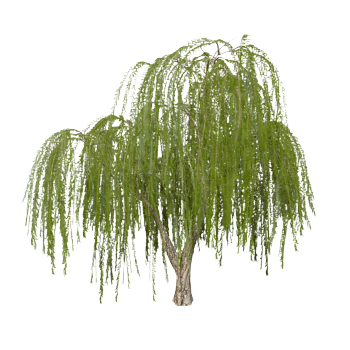
Willow tree 3D model
Willow trees are trees of the willow genus in the willow family. Branches are cylindrical in shape, with a nearly circular pith; No apical buds, lateral buds usually adhere closely to the branch, and bud scales are single; Leaves alternate, sparsely opposite, usually narrow and long, often lanceolate, feather veins, serrated or entire, petiole short, with supporting leaves, often serrated; The inflorescence of the hibiscus is upright or obliquely spread, with the bracts covering the entire edge, and the pistil composed of two carpels; The capsule is split into two petals; The seeds are small and often dark brown in color. The flowering period is from February to March, and the fruiting period is from March to April. The name of willow tree comes from its head wood working method. The result of the head tree homework is to preserve the trunk for continuous use of the branches, and the pronunciation of the word "willow" is the same as that of "liu", hence the name "willow tree".

A pair of lychees
Litchi chinensis Sonn. is an evergreen tree of the Lychee genus in the Sapindaceae family. Litchi has even feathered compound leaves, hairless, stalked, and slender lateral veins; No petals; The fruit nucleus is fruit shaped and nearly spherical; The seeds are all wrapped in fleshy false seeds. The flowering period of lychee is from March to April, and the fruiting period is from May to August. The name Litchi comes from Sima Xiangru's "Shanglin Fu", which was written as "Lizhi" in the text, and later changed to "Litchi" around the Eastern Han Dynasty.
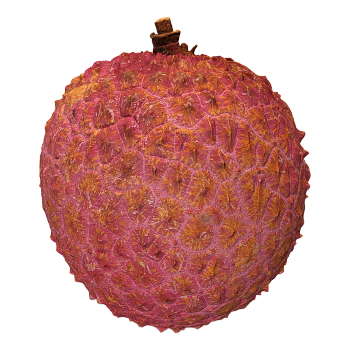
Litchi 3D model
Litchi chinensis Sonn. is an evergreen tree of the Lychee genus in the Sapindaceae family. Litchi has even feathered compound leaves, hairless, stalked, and slender lateral veins; No petals; The fruit nucleus is fruit shaped and nearly spherical; The seeds are all wrapped in fleshy false seeds. The flowering period of lychee is from March to April, and the fruiting period is from May to August. The name Litchi comes from Sima Xiangru's "Shanglin Fu", which was written as "Lizhi" in the text, and later changed to "Litchi" around the Eastern Han Dynasty.

Avocado
Avocado (scientific name: Persea Americana Mill.) is a evergreen tree and shade tolerant plant in the family Lauraceae, belonging to the genus Avocado. About 10 meters high, with gray green bark and longitudinal cracks. Leaves alternate, long elliptical, elliptical, ovate or ovate, apex extremely pointed, base wedge-shaped, extremely pointed to nearly circular, leathery, green on top, usually slightly pale below. The flowers are light green with yellow, 5-6 millimeters long, and the flower stalks are up to 6 millimeters long, densely covered with yellow brown short hairs. The flower is densely covered with yellow brown short hairs on both sides. The fruit is large, usually pear shaped, sometimes oval or spherical, yellow green or reddish brown, with cork like outer skin and fleshy middle skin.

Cypress bonsai
It is a form of bonsai art featuring side cypress trees, loved by bonsai enthusiasts for its unique shape and vitality. Cypress, belonging to the Cypress family and the Cypress genus, is an evergreen tree native to China and later introduced to various parts of the world. Usually, young seedlings or small plants of Platycodon grandiflorus are selected for production, and various shapes are created through pruning, shaping, grafting, and other methods. The branches and leaves of Platycodon grandiflorus are dense, the trunk is vigorous and powerful, and the bark is scaly. These characteristics make Platycodon grandiflorus bonsai highly ornamental. Not only can it beautify the environment, but it also has the function of purifying the air and absorbing harmful substances. It is also a part of traditional Chinese culture.

Palm saplings
Trachycarpus fortunei is an evergreen tree in the palm family, with a cylindrical trunk; Leaves nearly circular, petioles with fine rounded teeth; Flowers small yellow green, ovoid, forming branched or unbranched inflorescences, with large and multi branched inflorescences; The fruit is broad kidney shaped, with a navel and white powder, and changes from yellow to light blue when ripe; Seed endosperm keratin; The flowering period is in April and the fruiting period is in December. The name "palm" first appeared in the Chinese pre Qin literature "Shan Hai Jing", which states that "the mountains of stone and green are mostly made of brown wood". Li Shizhen named the palm, also known as the bamboo palm, in the Compendium of Materia Medica. It is named after the hair strands in its skin that resemble the mane of a horse.
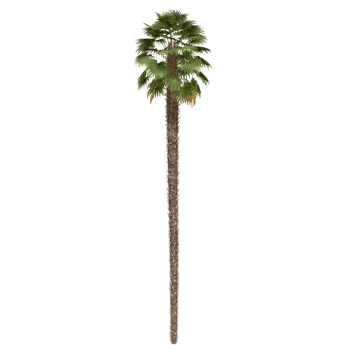
Palm tree
Trachycarpus fortunei is an evergreen tree in the palm family, with a cylindrical trunk; Leaves nearly circular, petioles with fine rounded teeth; Flowers small yellow green, ovoid, forming branched or unbranched inflorescences, with large and multi branched inflorescences; The fruit is broad kidney shaped, with a navel and white powder, and changes from yellow to light blue when ripe; Seed endosperm keratin; The flowering period is in April and the fruiting period is in December. The name "palm" first appeared in the Chinese pre Qin literature "Shan Hai Jing", which states that "the mountains of stone and green are mostly made of brown wood". Li Shizhen named the palm, also known as the bamboo palm, in the Compendium of Materia Medica. It is named after the hair strands in its skin that resemble the mane of a horse.
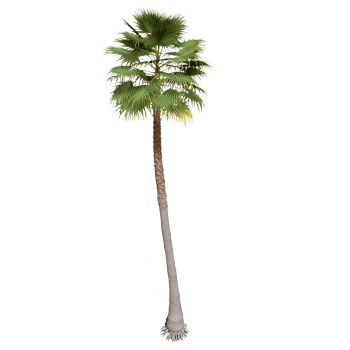
Da Si Kui
Da Si Kui is a tree like species in the palm family, belonging to the genus Si Kui; The base of the tree trunk swells and is covered with dead leaves, appearing light brown with circular leaf scars and indistinct longitudinal cracks; The leaves are bright green, and the edges of young leaf lobes have filamentous fibers that disappear with age. The petioles are thick and light reddish brown; The inflorescence is longer than the leaves, drooping, the flowers are solitary, the sepals are bell shaped, the corollas are longer than the sepals, the stamens are equal in length to the petals, and the anthers are linear and arrow shaped; The fruit is small, wide elliptical, ovoid or spherical in shape, with thin inner skin and shell texture; Seeds elliptical or ovoid, slightly flattened; The flowering period is from May to June, and the fruiting period is in September. Originating from the northwest of Mexico. In southern China, there is introduced cultivation, often grown together with silk sunflower.

Palm clusters
Trachycarpus fortunei is an evergreen tree in the palm family, with a cylindrical trunk; Leaves nearly circular, petioles with fine rounded teeth; Flowers small yellow green, ovoid, forming branched or unbranched inflorescences, with large and multi branched inflorescences; The fruit is broad kidney shaped, with a navel and white powder, and changes from yellow to light blue when ripe; Seed endosperm keratin; The flowering period is in April and the fruiting period is in December. The name "palm" first appeared in the Chinese pre Qin literature "Shan Hai Jing", which states that "the mountains of stone and green are mostly made of brown wood". Li Shizhen named the palm, also known as the bamboo palm, in the Compendium of Materia Medica. It is named after the hair strands in its skin that resemble the mane of a horse.

Coastal maple fruit
Evergreen trees, about 5-7 meters tall. The bark is rough, light gray brown or dark gray. Small branches thin and hairless; At that time, the branches were purple or light purple green; Perennial branches light purple brown or light purple, with oval or circular pores. Winter buds are light brown, oval in shape, with the edges of the scales slightly covered by eyelashes.

Mango saplings
Mango tree (scientific name: Mangifera indica), also known as lemon fruit tree or mango fruit tree, is a plant of the mango genus. Its fruit is mango, native to northeastern South Asia and the Indochinese Peninsula. It is called ā mra in Sanskrit, transliterated as "anluo". It prefers high temperature and dry weather, and the most suitable temperature for its nutritional growth period (roots, stems, leaves) is 24-30 ℃. When the temperature drops below 18 ℃, it grows slowly and stops growing below 10 ℃. During the reproductive growth period (flowers, fruits), higher temperatures are required, and sandy soil with good drainage and humus content is most suitable, with a pH value of 5.5-7.5.

The mango tree
Mango tree (scientific name: Mangifera indica), also known as lemon fruit tree or mango fruit tree, is a plant of the mango genus. Its fruit is mango, native to northeastern South Asia and the Indochinese Peninsula. It is called ā mra in Sanskrit, transliterated as "anluo". It prefers high temperature and dry weather, and the most suitable temperature for its nutritional growth period (roots, stems, leaves) is 24-30 ℃. When the temperature drops below 18 ℃, it grows slowly and stops growing below 10 ℃. During the reproductive growth period (flowers, fruits), higher temperatures are required, and sandy soil with good drainage and humus content is most suitable, with a pH value of 5.5-7.5.

Blue pink spruce
Blue pink spruce is an evergreen tree of the spruce genus in the pine family. The plant reaches a height of 15 meters; Conical or columnar crown; The leaves are four edged, sharp and thick, with a blue-green color. They are arranged in a spiral shape on the gray twigs and grow upwards, with gray green wax powder; Male bulbous flowers are oval shaped and solitary, large and yellow green in color, clustered at the top of new branches. The flowering period is late April, and the cones mature from September to October. Blue pink spruce is native to the United States and was introduced to China in the late 1990s. It was introduced to Tieling City in 2002. Introduced and cultivated in Beijing, Liaoning and other places in China, and widely planted as ornamental trees in North America and Northern Europe. Cold resistant, drought resistant, air pollution resistant, light loving, slightly shade tolerant.

Fragrant Fir
Xiangzhi fir is an evergreen tree in the pine family, also known as Canadian fir, North American fir, and Balsan desert fir. Plants can grow up to 8-20 meters in height; The bark of the old tree is thick and dark reddish brown, with scaly lobes. The young trees are relatively smooth, gray, and the young branches are light yellow green with gray short hairs; Winter buds are small, nearly spherical or broadly ovoid, with resin; The leaves on a tree undergo significant changes, with two rows of flat, dark green leaves arranged on either side.

Popular Models
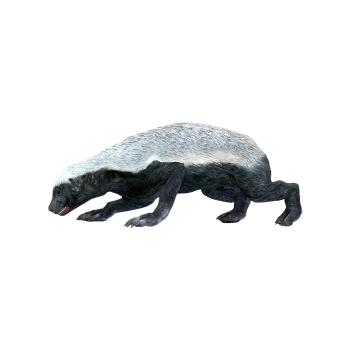
Honey Badger (3D animated model)
194 View
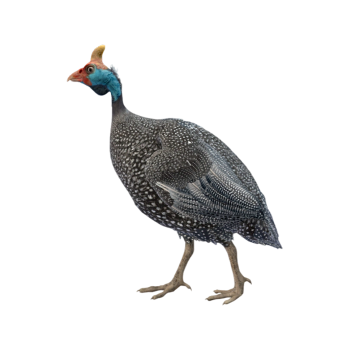
Guinea fowl (3D animated model)
165 View
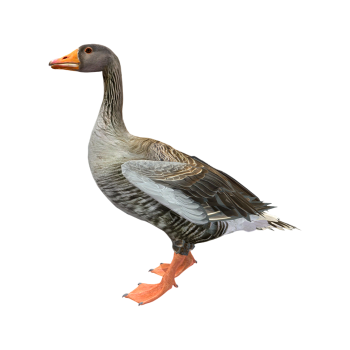
Wild Goose (3D animated model)
187 View
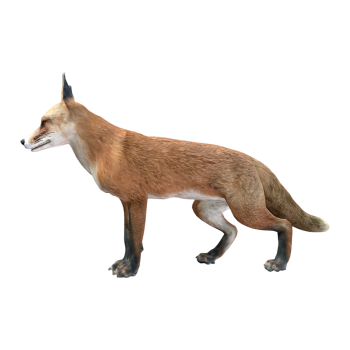
Red Fox (3D animated model)
155 View
Random Model

Cheetah (with 3D animated model)
817 View

Abandoned factory in Leipzig, Germany
1059 View

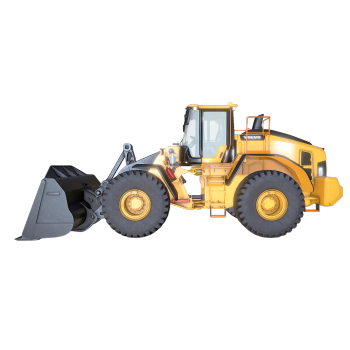
Volvo L220H wheel loader
1112 View


Red 125cc motorcycle
799 View

Rhino-JaroslavRóna
761 View

McLaren 720S-2017 supercar
1306 View

